


7 Mini Skid Steer Tips for Landscaping Jobs

Quick Summary
A mini skid steer is a compact tool carrier that lets landscaping crews move soil, grade beds and haul material in tight residential yards. Its small frame passes through side gates and turns in tight lots where a full-size loader cannot go. Choose the model by checking access width first, then rated operating capacity, lift height and ground pressure.
Measure the actual gate opening, since hinges and posts reduce the usable width.
Match rated operating capacity to the heaviest material you move routinely.
Check dump height against the side rail of the trailer or truck you use.
Confirm attachment mounting plate and hydraulic flow against the exact model before ordering.
Buy attachments in the order of the tasks you repeat, not the full catalog.
Which mini skid steer fits your yard?
Valley Equipment helps New England landscapers match a compact machine to their property and tasks.
Table of Contents
Why a Mini Skid Steer Fits Landscaping Work
Last Updated: November 19, 2026
A mini skid steer is the compact tool carrier that lets a landscaping crew move soil, grade beds and haul material without a full-size machine. Its compact frame and low center of gravity suit most residential and small commercial yards. Valley Equipment supplies mowers, mini excavators and mini skid steers, and the jobs that stall are the ones where the machine cannot fit through the gate.
A mini skid steer clears side gates, turns in tight town lots and works along fences without damaging plantings, where a full-size loader would tear up lawns or require a trailer and permits. A mini skid steer can take over spreading topsoil, leveling beds and clearing brush, letting one operator do work that would otherwise take a crew with wheelbarrows.
Choosing the Right Mini Skid Steer Model for Your Property
Model selection should follow a fixed sequence: access, capacity, lift height, weight and ground pressure, then controls. Run the numbers in that order and most of the field narrows itself.
Step 1: Access. Measure the narrowest gate, the tightest turn between obstacles, and overhead clearance such as tree limbs or a carport. A machine that cannot pass the gate does no work, so width is the first filter. Measure the actual opening, not the nominal gate size, because hinges and posts eat several inches.
Step 2: Rated operating capacity (ROC). Match ROC to the heaviest material you move routinely, not the heaviest you might move once. Mulch and dry topsoil are light; saturated soil, gravel and stone are heavy. Match routine loads to the machine's rated operating capacity, and if you routinely move pallets of sod or stone, size up rather than pushing a smaller machine to its limit.
Step 3: Lift height and reach. Check hinge-pin and dump height against the side height of the trailer or truck you actually use, because a machine that cannot clear the side rail forces a second handling step.
Step 4: Weight and ground pressure. Machine weight plus attachment weight plus load determines ground pressure. On finished lawns and wet ground, track machines spread load better than wheeled units, and wider tracks spread it further. On established turf, plan matting or plywood paths at the gate and along the primary route.
Step 5: Controls and service access. Compare joystick versus hand-and-foot controls, and check how easily you can reach filters, grease points and the engine compartment. A machine that is awkward to service tends to get serviced late.
Watch out: buying on rated capacity alone and ignoring width is the most common selection error, a high-capacity machine that cannot reach the backyard is worth less than a smaller one that can.
A comparison sheet with columns for width, ROC, dump height, operating weight and control type makes the trade-offs visible. You can browse the full range of skid steer loaders to compare models side by side. Fill it in for two or three candidate models and take it to the dealer so the conversation stays on your property's constraints rather than the brochure.
Mini Skid Steer Attachments for Landscaping
Attachments are where a mini skid steer earns its keep, but the right set depends on the tasks you repeat, not the longest catalog. The table below maps common landscaping jobs to the attachment that suits them and the compatibility check to run before you buy.

Task | Attachment | Compatibility check |
Moving soil, mulch, gravel | Bucket (standard or light-material) | Bucket width versus gate and bed width; cutting edge type |
Leveling and smoothing topsoil | Landscape rake or power rake | Mounting plate style; rake width versus machine width |
Breaking up compacted beds | Rotary tiller | Hydraulic flow requirement (GPM) versus machine auxiliary flow |
Drilling post holes for fencing or plantings | Auger with appropriate bit diameter | Auger drive flow and pressure rating; bit diameter versus hole size |
Clearing brush and small trees | Brush cutter or grapple | Hydraulic flow and pressure; weight versus ROC |
Grading and back-dragging | Grader blade or box blade | Mounting plate; blade width versus machine track width |
Hauling pallets of sod or stone | Pallet forks | Fork tine length and spacing; ROC versus pallet weight |
Trencing for irrigation or edging | Trencher | Hydraulic flow; chain type for soil conditions |
Aerating and overseeding | Aerator or seeder | Flow requirement; weight versus turf sensitivity |
Compatibility checks that matter most. Confirm the mounting plate style against the exact model before ordering. Confirm the machine's auxiliary hydraulic flow in gallons per minute (GPM) and pressure against the attachment's requirement; an under-flowed attachment runs slow or stalls. Confirm the attachment's weight against the machine's ROC, because a heavy attachment eats into the load you can carry. Confirm the attachment's width against your gate and bed dimensions.
Buy in task order, not catalog order. Buying the full set on day one ties up capital in idle attachments.
Verify the mounting plate and hydraulic flow against the exact model before ordering.
Mini Excavator vs Skid Steer for Grading
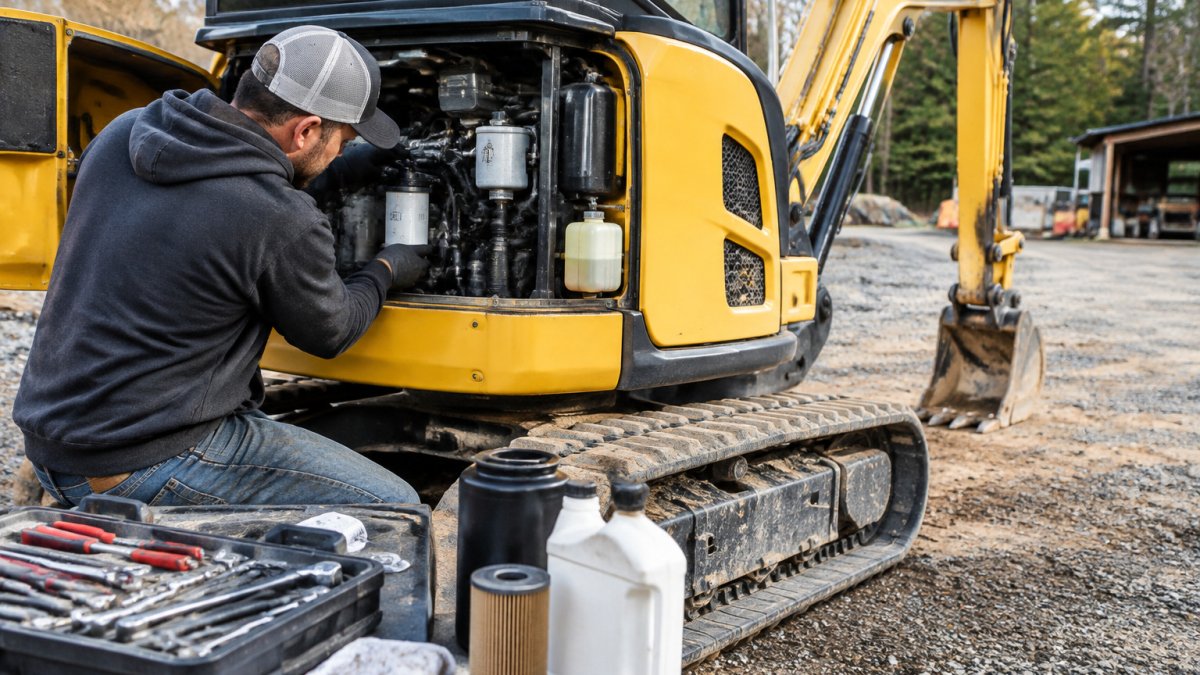
A mini excavator reaches farther and digs deeper, while a skid steer moves material faster across flat or gently sloped ground. For fine grading across a large open area, a skid steer moves material across flat or gently sloped ground. For trenching or work near a foundation, a mini excavator's reach and digging depth are the better fit. Our complete buyer's guide to choosing a mini excavator walks through the decision step by step. Learn how to maintain a mini excavator with a step-by-step schedule to keep one running well.
Many grading jobs use both. If you are deciding where to start, consider how much of your work is digging versus moving and leveling material.
Next step: Tell us about your property and the jobs you run most often, and our team will help you narrow the field. Valley Equipment carries authorized Wright, Rippa and Huayee machines along with parts and service support, so you can get the right machine and keep it running.
Frequently Asked Questions
What is the primary advantage of a mini skid steer in landscaping?
A mini skid steer is compact enough to pass through gates, side yards and narrow lots while still lifting and moving real material. Its low center of gravity and tight turning radius let operators work close to fences, patios and planting beds without damaging surrounding areas. Paired with attachments such as a landscape rake, tiller or auger, one machine can handle grading, soil preparation and material handling. Pricing depends on quantity, dates and delivery, so request a current quote from Valley Equipment for specific models.
Can a mini skid steer handle heavy-duty grading tasks?
Yes, for many residential and small commercial grading jobs. Check the rated operating capacity and lift height against the material weight you plan to move, and match the attachment to the task, such as a grading bucket or landscape rake for finish grading. Very large earthmoving or deep trenching typically calls for a larger machine. Valley Equipment can help you compare models for your site's scope before you buy or rent.
Is it better to rent or buy a mini skid steer for a small landscaping business?
Renting suits seasonal peaks or one-off projects, while buying makes sense when the machine will work most weeks of the year. Compare the total cost of ownership, including maintenance, storage and transport, against expected rental days. Valley Equipment can provide current pricing and service options so you can run the numbers for your workload.
Comments